Hoist Trolleys

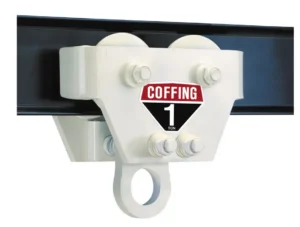
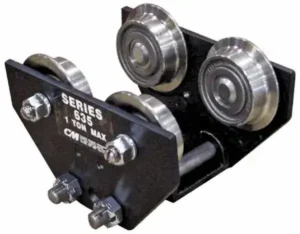
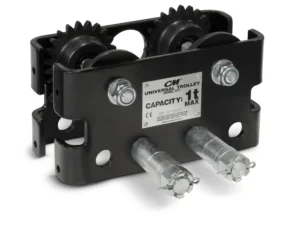
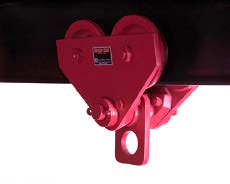
Manual and motorized trolleys for monorail and bridge crane applications.

Hoist Trolleys for Every Configuration.

 For load positioning. Filter by mount configuration, and series to find the right unit.

Filter products

Your results will change based on your selections

Use of search implies consent to our privacy policy.

Unplanned Downtime Starts With the Wrong Specification.

Get the hoist trolley for your application, your environment, and your duty cycle before the order.

Talk to a Rep Today

Industrial hoist hangs in dimly lit warehouse; logos for CM, Coffing Hoists, CM ET, Chester Hoist, and Budgit Hoists are displayed on the right.

The Brands Your Facility Has Been Running for Decades

Manual hoists are backed by the same engineering standards and parts continuity your facility has relied on for years.

One manufacturer, one place to specify, source, and support all of it.

Get to Know Our Brands

Is a Hoist Trolley Right for Your Application?

A hoist trolley is the essential component that converts a fixed lifting point into a flexible, two-dimensional material handling tool. Selecting the right trolley type for the beam, load, duty cycle, and environment is as important as selecting the hoist itself.

Loads need to move both vertically and horizontally

A fixed hoist only lifts and lowers directly below its mounting point. The moment a load needs to travel horizontally — even a metre — a trolley is required for safe, controlled movement.

The lifting area spans multiple workstations or pick points

When one hoist must serve several positions across a bay, aisle, or production line, a trolley on a runway beam allows that single hoist to reach every point within its travel range, maximizing equipment utilization.

Pushing or pulling a suspended load by hand is unsafe

A suspended load swinging freely is a serious hazard. A trolley constrains horizontal movement to a defined beam axis, providing controlled, predictable travel rather than uncontrolled pendulum motion.

Headroom is limited and hook height must be maximized

Low-headroom trolleys keep the hoist as close to the beam as possible, maximizing the available lift height between the floor and the structure above.

Hoist Trolley FAQs

A push trolley is moved by the operator physically pushing the hoist or load along the beam. It is simplest, lowest cost, and works well for light loads and infrequent use where the operator can safely apply lateral force. A geared trolley uses a hand chain to drive the wheels mechanically, allowing heavier loads to be traversed without the operator needing to push against the load directly.

Trolleys are specified by the beam flange width range they accept — for example, 50–127 mm or 100–178 mm flange width. The trolley’s wheel gauge and side plate spread are adjusted (via shims or spacers) to fit within this range. Always check the beam flange width, flange thickness, and confirm the beam’s load rating before selecting a trolley.

Trolley maintenance is straightforward. Key tasks include regular inspection of wheel wear and flange condition, lubrication of wheel bearings and the gearbox (motorized trolleys), checking and tightening suspension bolts and hanger rods, inspection of the hand chain (geared trolleys) for stretch and wear, checking motor brushes and electrical connections (motorized trolleys), and ensuring end stops and bumpers are in place and serviceable. Trolley wheels should be checked for flat spots caused by emergency braking or overloading.
Need Help Matching a Hoist to Your Application?

Load capacity, mounting configuration, environment rating, and duty cycle all affect the right specification. A distributor familiar with your application can confirm the right unit before the order.

Get Your Application Specified Today