Heavy Industrial Manufacturing

Heavy equipment manufacturing is a demanding sector where lifting and material handling systems play a critical role across every stage of production.

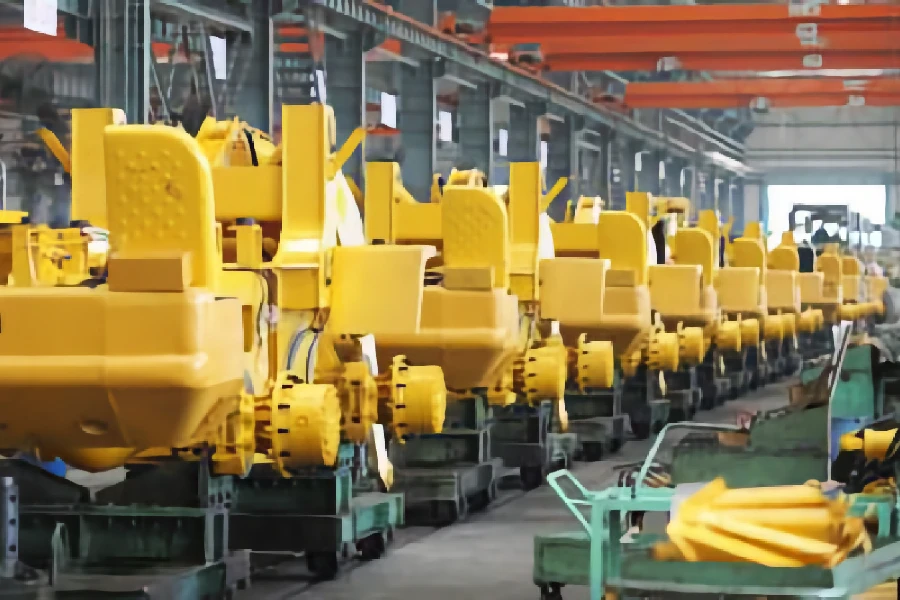
Rows of yellow industrial machinery parts are lined up in a large factory or warehouse with an overhead crane system.

Heavy Industrial Manufacturing Facility Hoist Applications

Major OEMs operate massive facilities where components ranging from bulldozer mainframes and excavator booms to diesel engines and hydraulic cylinders must be moved continuously through fabrication, assembly, and finishing operations. What sets this industry apart is the sheer scale of the loads involved — components that would be finished products in other industries are often just single subassemblies here, requiring lifting systems rated for thousands of pounds and capable of running non-stop across multiple shifts.

  • Paint and Coating Lines
  • Engine & Powertrain Build
  • Cab Assembly & Glazing
  • Boom, Stick & Structural Fabrication
  • Transmission & Hydraulic System Build
  • Undercarriage Component Assembly

Is an Air or Electric Chain Hoist Right for Your Application?

Air chain hoists dominate in hazardous zones like paint and coating lines, foundries, and high-cycle welding cells, where flammable atmospheres, extreme heat, and continuous-duty demand make pneumatic equipment the only practical or safe choice.

Electric chain hoists work well in final assembly, engine build, precision machining, and warehousing operations, where programmable positioning, variable frequency drives, and automation integration deliver the accuracy and repeatability needed for precision component mating and high-throughput production. Large heavy equipment campuses typically rely on both technologies extensively, carefully matching each to the specific demands of every production zone.


Final Assembly Lines

The heart of any heavy equipment manufacturing plant is the final assembly line, where major subassemblies — cab, powertrain, hydraulic system, boom and attachment — are joined to the base machine. Electric chain hoists on overhead bridge cranes and workstation jib cranes handle every major installation: lowering engine-transmission packages into frames, mating front and rear axle assemblies, setting cabs onto ROPS structures, and installing booms and lift arms.
Paint & Coating Lines

These environments carry hazardous area classifications due to solvent vapors and combustible particulate. Air hoists on monorail conveyor systems carry components through spray booths and drying ovens, where electrical spark-producing equipment is prohibited. The continuous-duty capability of pneumatic hoists is also a natural fit for the non-stop cycling of a high-throughput coating line.

Casting & Fountry Operations

Cylinder blocks, transmission housings, final drive cases, counterweights — use air hoists in areas adjacent to furnaces, pouring stations, and sand shakeout equipment. The combination of heat, combustible dust, and continuous cycles makes pneumatic hoists the standard in these zones.

Transmission & Hydraulic System Build

Electric hoists provide the smooth, millimeter-level control required to assemble planetary gear sets, clutch packs, and valve bodies onto fixtures without damaging precision-finished bores and gear surfaces.

Explore Hoists Made for the Heavy Manufacturing Industry

Filter by mount configuration, capacity, lift speed or voltage to find the right unit to meet the needs of your industry.

Filter products

Your results will change based on your selections

Use of search implies consent to our privacy policy.

Need Help Matching a Hoist to Your Application?

Load capacity, mounting configuration, environment rating, and duty cycle all affect the right specification. A distributor familiar with your application can confirm the right unit before the order.

Get Your Application Specified Today