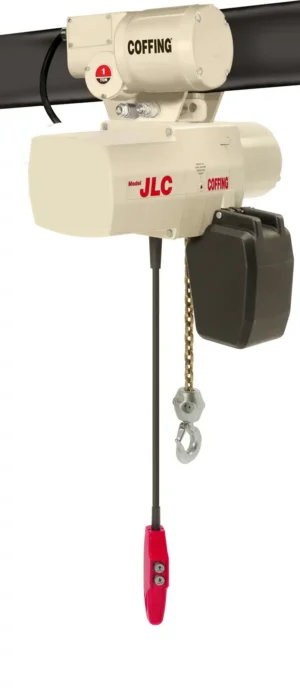
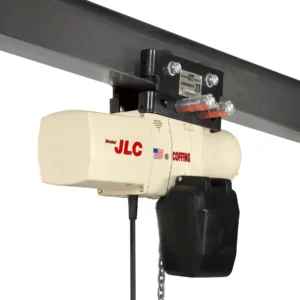
Electric chain hoists deliver power and reliability for even your most heavy-duty lifting applications. Our electric chain hoist portfolio can be modified and engineered to your exact requirements with a variety of options and features. Browse our electric chain hoists that are available in numerous capacities, lifts, and configurations.
Electric Chain Hoists for Every Configuration.
Coffing and Chester, Budgit and CM by Stuart Rush electric chain hoists for overhead lifting, load positioning. Filter by mount configuration, capacity, lift speed or voltage to find the right unit.
The Brands Your Facility Has Been Running for Decades
Electric chain hoists are backed by the same engineering standards and parts continuity your facility has relied on for years.
One manufacturer, one place to specify, source, and support all of it.
Is an Electric Chain Hoist Right for Your Application?
Use an electric chain hoist when a load is too heavy, too repetitive, or too risky to lift manually — and when precision, speed, and operator safety are priorities. They are the right tool when consistent, controlled vertical lifting is needed as part of a workflow, process, or operation.
Weight exceeds manual handling limits
Any lift beyond safe manual thresholds (typically 25 kg per person per lift under most occupational health guidelines) warrants mechanical assistance. Electric hoists eliminate ergonomic injury risk entirely.
Repetitive lifting cycles
When the same lift is performed many times per shift or day, an electric hoist dramatically reduces operator fatigue, improves consistency, and increases throughput versus manual or hand-chain alternatives.
Precision positioning is required
Electric hoists — especially those with variable frequency drives (VFD) — allow controlled, incremental movement for placing sensitive, expensive, or awkwardly shaped loads exactly where needed.
Restricted or elevated work areas
When workers cannot safely get underneath or around a load to reposition it manually, a hoist provides safe, remote-controlled handling.
Always select a hoist with a rated capacity (Working Load Limit / WLL) that exceeds your heaviest intended load. A common industry rule is to choose the next capacity class above your maximum load to maintain a safety margin.
Duty cycle refers to how intensively the hoist can be operated. It is classified by standards ranging from infrequent light use to continuous heavy-duty industrial use. Choosing the wrong duty class can lead to premature motor burnout.
Some hoists offer VFD control, which allows variable lifting speeds. This is useful for precision positioning of delicate or expensive loads, reducing shock loading, and improving cycle efficiency.
Need Help Matching a Hoist to Your Application?
Load capacity, mounting configuration, environment rating, and duty cycle all affect the right specification. A distributor familiar with your application can confirm the right unit before the order.