Air Hoists

Pneumatic hoists for a wide range of industrial environments. For use when the environment is hazardous, wet, or corrosive; when continuous duty operation is required; or when smooth variable-speed control is needed without electrical infrastructure. 

Air Hoists for Every Configuration.

CM by Stuart Rush and Chester air hoists for overhead lifting, load positioning. Filter by mount configuration, capacity, or lift speed to find the right unit.

Filter products

Your results will change based on your selections

Use of search implies consent to our privacy policy.

Unplanned Downtime Starts With the Wrong Specification.

Get the hoist rated for your application, your environment, and your duty cycle before the order.

Talk to a Rep Today

Industrial hoist hangs in dimly lit warehouse; logos for CM, Coffing Hoists, CM ET, Chester Hoist, and Budgit Hoists are displayed on the right.

The Brands Your Facility Has Been Running for Decades

Air hoists are backed by the same engineering standards and parts continuity your facility has relied on for years.

One manufacturer, one place to specify, source, and support all of it.

Get to Know Our Brands

Is an Air Chain Hoist Right for Your Application?

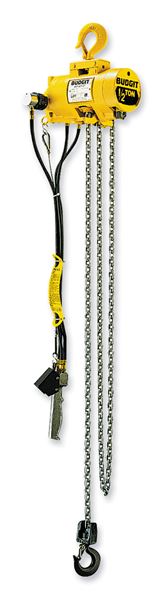
An air chain hoist (also called a pneumatic chain hoist) is a lifting device powered by compressed air rather than electricity. The air motor drives a gear train that moves a load chain to raise and lower heavy loads. They are controlled via a throttle valve — either a pendant or inline lever — and are widely regarded as the most reliable lifting solution in hazardous, wet, or explosive environments where electricity poses a risk.

Continuous or very high duty cycle operation required

Because air motors cannot thermally overload, they can run at 100% duty cycle indefinitely. For high-throughput production lines where a hoist runs almost constantly, air is the correct choice.

Smooth, variable-speed control is needed without VFD cost

The throttle valve on an air hoist gives infinitely variable speed control as standard — no additional inverter or drive is needed.

Portability and light weight are important

Air hoists are typically lighter than equivalent-capacity electric hoists, making them easier to reposition between lifting points in maintenance applications.

Compressed air infrastructure already exists

In plants where a compressed air ring main is already installed, adding an air hoist is operationally straightforward and avoids electrical installation costs.

Air Hoist FAQs

Speed is controlled by the degree to which the throttle valve is opened — more airflow means faster speed. This gives smooth, stepless variable speed as standard without any additional electronics. Some hoists also offer two-speed operation via a secondary throttle circuit.

The air motor simply stalls when the load exceeds its capacity — it cannot burn out like an electric motor. However, the load chain, hooks, and gearbox can still be damaged by severe overloading, so rated capacity must always be respected. Many modern air hoists include a pneumatic overload device that cuts air supply when the rated load is exceeded.

Air hoists are among the simplest hoists to maintain. Key tasks include regular FRL unit servicing (drain moisture trap, refill lubricator), periodic inspection of the load chain for stretch, wear, and corrosion, hook inspection for deformation and cracks, throttle valve cleaning, and occasional vane motor rebuild (vane replacement is a straightforward workshop task).
Need Help Matching a Hoist to Your Application?

Load capacity, mounting configuration, environment rating, and duty cycle all affect the right specification. A distributor familiar with your application can confirm the right unit before the order.

Get Your Application Specified Today