
HOISTWISE — A SAFETY SERIES
Two minutes that can make your day. How to Inspect your Hoist Hook:
Most operators look at the hook. Few know what they’re actually looking for. Here’s what to check before your shift starts.
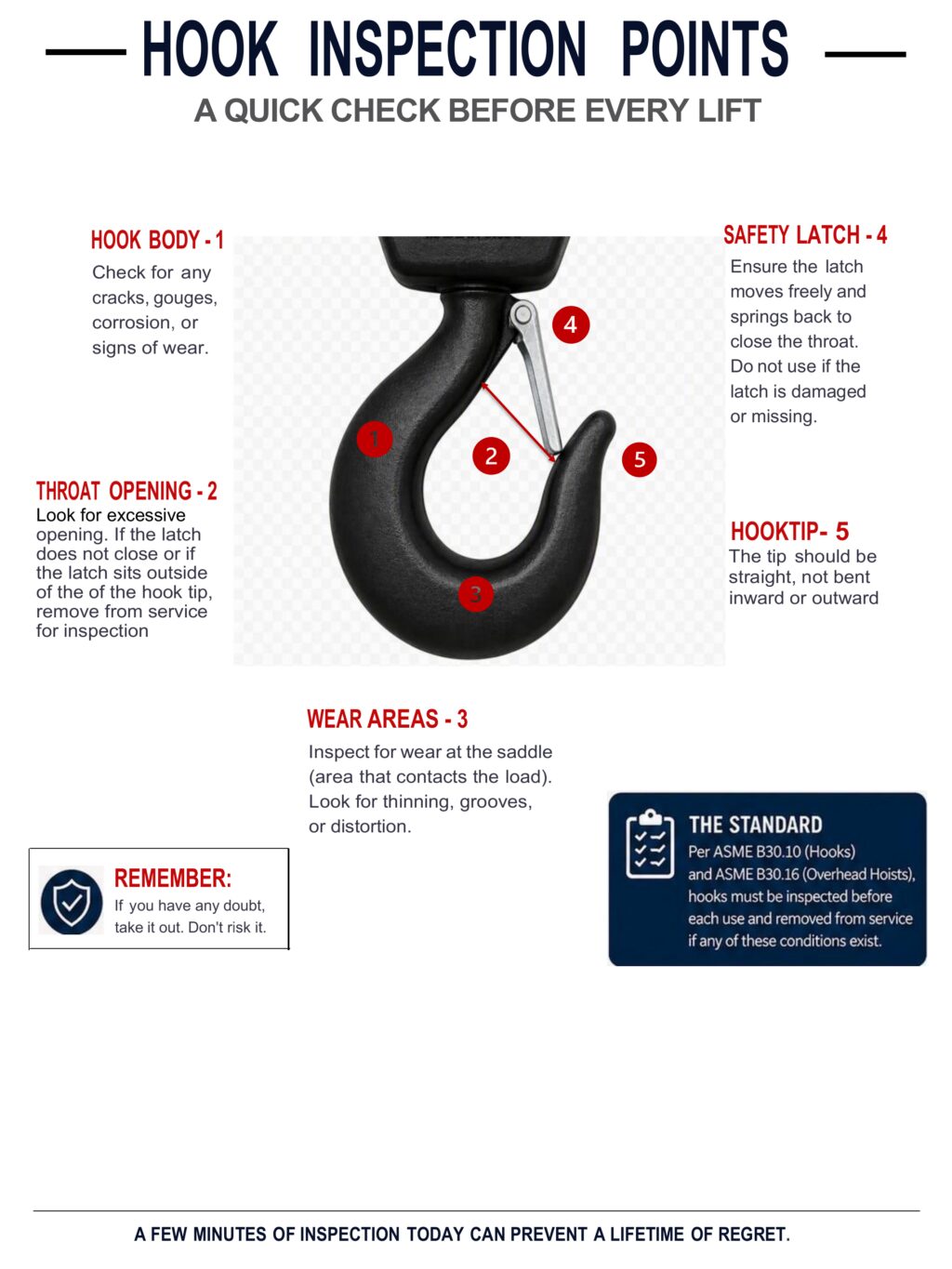
- Hook body. No cracks, no gouges, not bent.
- Throat opening. Not visibly spread -if the latch sits past the hook tip, that’s an indication that the hook has been overloaded.
- Hook tip. Straight, not bent inward or outward.
- Safety latch. In place and springs fully closed when released.
- Rotation. Turns freely, no binding or grinding.
The standard is clear.
Per ASME B30.10 (Hooks) and ASME B30.16 (Overhead Hoists), hooks must be visually inspected before each shift by the operator.
Any hook showing these conditions must be removed from service immediately and tagged for further inspection. A damaged latch can often be replaced; a deformed or cracked hook body cannot — it’s out of service
No exceptions. No “I’ll check it next time.”
What damages a hook
Deformation in a hook is rarely random. It is almost always a sign of overload, side loading, or improper rigging. That is why the visual check matters: a bent tip or a spread throat is not a cosmetic issue; it is evidence that the hook has already been stressed beyond what it was built for. Once that happens, the hook’s strength cannot be assumed even if it still looks like it can carry the load.
Hooks in heavy or severe service, or used on critical lifts, may require periodic nondestructive testing in addition to daily visual checks and periodic inspections.
Stay Hoistwise:
Tip loading is the easiest way to damage a hook. Keep the load in the saddle, not the tip.
Latches are designed to keep rigging and slings in the hook under slack, no load, conditions. Latches are not designed to carry a load. When making a lift, bring the hook up slowly and watch to confirm the load settles into the saddle.
Does my hook need a latch?
Yes. If the hook has a hole for a latch, a latch is required.
Remember, two minutes can make your day, Stay Hoistwise
STUART RUSH | HOISTWISE SAFETY SERIES | EDITION 02