
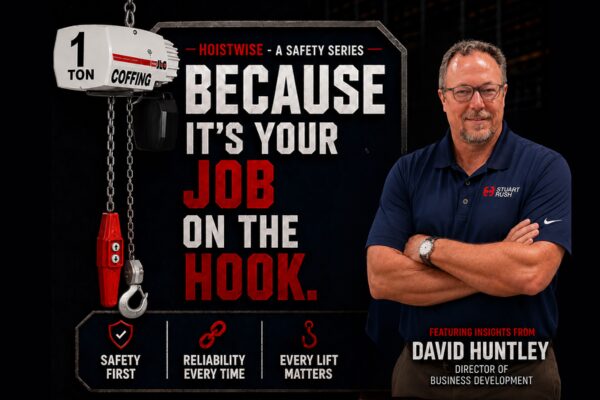
HOISTWISE — A SAFETY SERIES
A Chain Is Only as Strong as Its Weakest Link:
How to Inspect Your Hoist Load Chain
A chain is only as strong as its weakest link, and in the lifting industry, that’s not just a proverb; it’s a safety reality. When it comes to your hoist’s load chain, that reality has real consequences. The good news? Visual inspection of your load chain is one of the easiest and most impactful maintenance tasks you can perform. Done consistently, it can dramatically increase your hoist’s uptime and keep your crew safe.
How Often Should You Inspect?
Inspection frequency isn’t one-size-fits-all. It depends on the duty level of your hoist, how hard and how often it’s being used. Refer to your hoist’s manual or duty classification (H1 through H5) to determine the appropriate inspection interval. A hoist used for occasional light lifts doesn’t need the same attention as one running multiple shifts a day at near-capacity loads.
What to Look For
When you handle the load chain for inspection, you’re scanning for several key defects:
Surface Damage
Run your eyes, and if safe, your hands along every link looking for:
- Nicks — sharp indentations that act as stress risers
- Gouges — material removal that reduces cross-section
- Pitting — corrosion-related surface cavities that weaken the metal
- Weld splatter — hardened metal deposits from nearby welding that can create stress points or indicate heat exposure
Any of these defects can compromise the chain’s rated capacity and should be evaluated against your hoist manufacturer’s rejection criteria.
Chain Twist (Double-Reeved Units)
If you’re working with a double-reeved hoist, pay special attention to chain twist. A capsized load block, one that has flipped or rotated, will introduce a twist into the chain that causes uneven loading across the links. Even a partial twist can significantly reduce the chain’s effective working load. Inspect the full length of the chain and ensure it runs straight and true from the dead-end anchor to the load hook.
Inter-Link Wear
The contact points between links are where wear accumulates silently over time. Check the inside contact surfaces of each link carefully. This wear reduces the diameter of the chain bar, which directly reduces the chain’s load capacity. If you notice visible wear in these areas, it’s time to measure.
Checking for Chain Elongation
If inter-link wear is present, the next step is to check for chain elongation, an increase in pitch length caused by wear at the contact points. Your hoist manual will specify the maximum allowable elongation (typically expressed as a percentage) and the procedure for measuring it. Do not skip this step if wear is visible; a worn chain that has elongated beyond limits must be replaced immediately.
Don’t Skip Lubrication
Once the inspection is complete and no rejection criteria have been met, lubricate the chain. This isn’t optional; it’s what keeps the next inspection looking just as good as this one.
Use a lubricant recommended by your hoist manufacturer and take the time to work it into the inter-link contact areas, not just the outer surfaces. Those internal contact points are where friction and wear occur. Surface-only lubrication does relatively little to extend chain life; getting lubricant into the gaps between links is what makes the difference.
Proper lubrication reduces wear, prevents corrosion, and can significantly extend the service life of your load chain.
A Simple Habit That Pays Off
Load chain inspection takes only a few minutes, but the payoff is enormous: fewer unexpected failures, longer chain life, reduced downtime, and, most importantly, a safer lift every time. Make it a regular part of your preventive maintenance routine, document what you find, and always follow your manufacturer’s guidance on rejection criteria and replacement.
Your chain is the final link between the load and the hook. Treat it accordingly.
This is HoistWise. Because it’s your job on the hook.
Always refer to your hoist manufacturer’s manual for model-specific inspection criteria, elongation limits, and lubrication recommendations.
STUART RUSH | HOISTWISE SAFETY SERIES | EDITION 01